See
Live operational truth
Edge capture, systems of record, and returning results give the platform a current picture of what is happening across the line, the cloud, and the control plane.
Operator-Guided Autonomy | Orchestration | Trustworthy Execution
Auto-Mate turns edge signal, local reasoning, and governed orchestration into one clear operating loop. Mate helps operators understand what is happening, decide what matters, and move work forward without giving up authority.
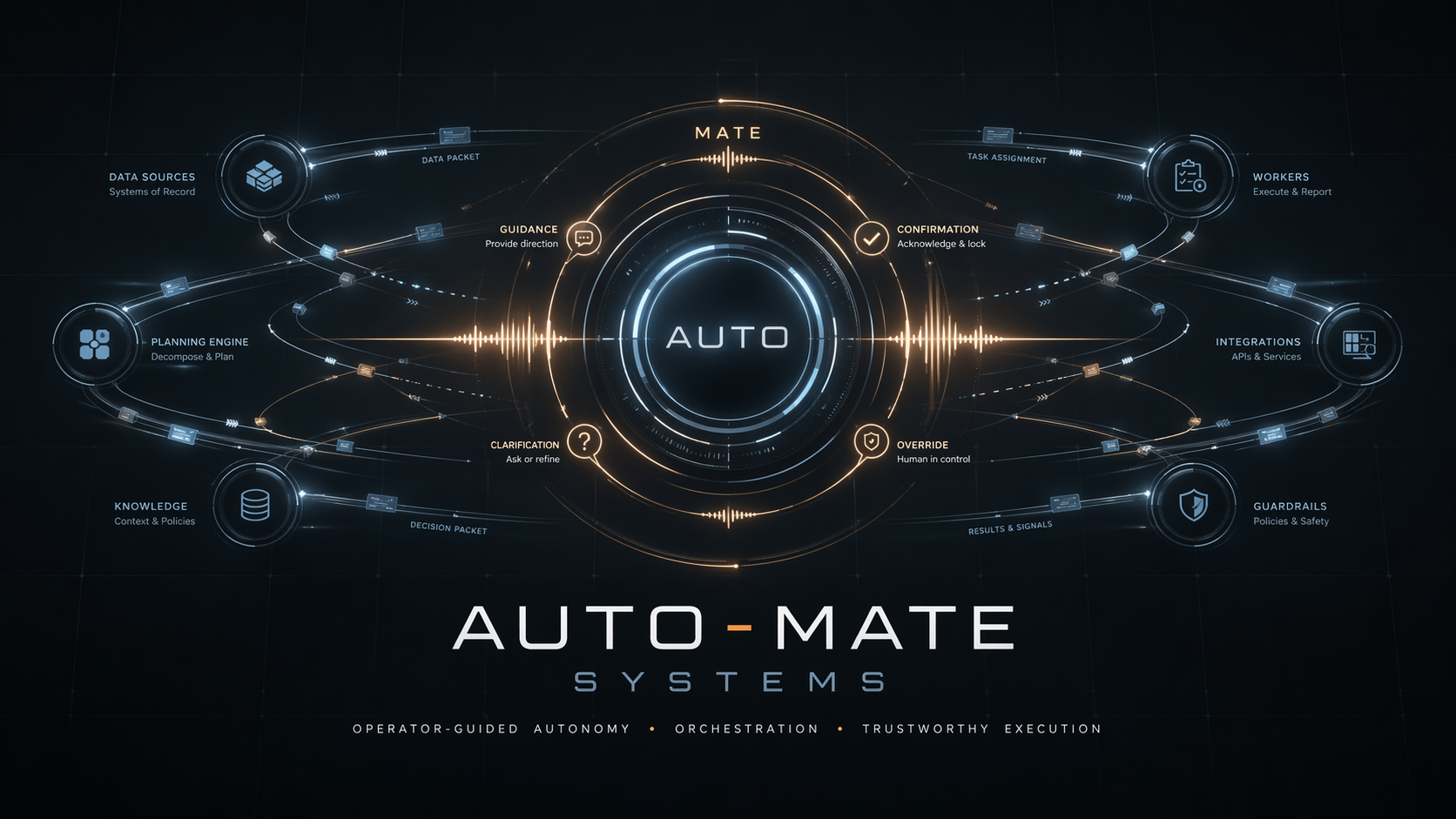
The visual above is the product in one frame. Systems of record, planning, and knowledge feed the center. Human guidance, clarification, confirmation, and override stay in the loop. Guardrails, integrations, and workers turn approved decisions into action. Results come back as fresh signal so the platform can keep operating on truth instead of stale intent.
See
Live operational truth
Edge capture, systems of record, and returning results give the platform a current picture of what is happening across the line, the cloud, and the control plane.
Decide
Context before action
Mate brings together planning, policy, local AI, and operator interaction so decisions are informed, explainable, and grounded in the real operating environment.
Move
Governed execution
Auto dispatches, Mate communicates, Guardrails constrain, and operators can confirm or override whenever the platform reaches a moment that should stay human-owned.
What The Graphic Means
At the center is the orchestration core: AUTO as the runtime coordinator, MATE as the named AI agent and operator-facing shell. Around that core are the inputs that shape action, the controls that keep humans present, and the systems that make approved decisions real in the world.
Center Of Gravity
AUTO coordinates execution state, continuity, and next-step logic. MATE is the AI agent the operator works with to interpret state, shape plans, and keep the runtime understandable.
Inputs That Matter
Instead of improvising from a prompt, the platform works from systems of record, local context, policies, and explicit planning logic that turn intent into a practical path forward.
Effects In The World
The platform can route work into real systems and real teams, but only through the guardrails that define what is safe, compliant, and actually allowed.
Closed Loop
Completion reports, telemetry, and anomalies come back into the same control plane, which means the next recommendation starts from what actually happened rather than what was merely intended.
Why Buyers Trust It
These four interaction modes are the reason Auto-Mate stays operator-guided instead of drifting into vague autonomy theater. The system can move quickly, but it still knows when to ask, when to wait, and when to hand control back.
Guidance
Operators give the platform its objective, priority, and posture so the loop starts from human intent instead of machine momentum.
Clarification
When the context is incomplete or a choice would be risky, Mate asks instead of guessing. That keeps ambiguity from turning into bad action later.
Confirmation
Critical steps can be explicitly confirmed before they execute, giving the platform a clear, auditable handoff from recommendation to approved action.
Override
Override is the hard stop, the reroute, and the emergency exit. The operator can seize control at any point without negotiating with the system.
Platform Proof
This is where the architecture proves the positioning. Auto-Mate is not a chatbot pasted over operations. It has explicit places for data, policy, planning, execution, integrations, and hard controls.
Data Sources
ERPs, MES databases, PLCs, sensors, and line-side runtime feeds provide the factual layer that keeps the platform anchored to the real operating environment.
Planning Engine
Intent becomes a task graph, with dependencies and next steps that can actually be executed, reviewed, and resumed when conditions change.
Knowledge
Local operating context, SOPs, and compliance requirements give the platform the policy memory it needs to reason inside the customer's world.
Workers
Workers can be people, robots, automations, or software agents. They carry out approved work and return completion state, telemetry, and outcome signals.
Integrations
Integrations let Auto-Mate reach the systems that already run the business, rather than forcing operations through one narrow surface.
Guardrails
Guardrails are the hard boundaries. They apply policy, breaker logic, safety rules, and compliance limits before the platform is allowed to move.
What Moves Through The Loop
That matters because it makes the system explainable. You can see what came in, what was decided, what was assigned, and what returned from the field.
Data Packet
Readings, records, and line-side events flow inward from data sources and runtime capture to update the platform's picture of reality.
Task Assignment
Once planning, human input, and guardrails align, work moves outward as a routed assignment to the right system, team, or worker.
Decision Packet
Confirmed direction, clarifications, and acknowledgements return to the core as explicit human decisions the platform can honor and audit.
Results & Signals
Completion reports, telemetry, sensor updates, and anomalies come back from execution so the next step begins from outcomes, not assumptions.
How The Loop Closes
Auto-Mate is designed so the platform does not jump from signal to action without context, planning, human participation, and guardrails. That order is part of the product, not an implementation detail.
Override remains outside the normal sequence as an always-available emergency exit. At any point, the operator can pull control back and redirect the loop.
Where It Lives
This is the runtime stack underneath the brand. Each layer has a different job, and together they let Auto-Mate stay observable, local where it matters, and connected where it helps.
1. Edge Metrics Capture
The edge layer turns raw machine activity into ordered signal close to the line, preserving local sequencing and reliable handoff before anything leaves the site.
2. AWS Metric Projection
The cloud side — running on AWS, or on the customer’s own cloud — makes operational state visible, retainable, and usable for remote dashboards, alerts, and fleet-wide views, without pretending the cloud is the source of protected local truth.
3. On-Site Host & Local AI
The platform can be hosted locally on a single on-premise node — database, protected logic, and local mixture-of-experts models all running inside the customer’s environment. The deepest reasoning happens on site, so sensitive operating context never has to leave the building to stay useful, and the system keeps working even with no connection to the cloud.
4. Orchestration Platform
This is where the operating model becomes runtime behavior: Auto manages dispatch, Mate keeps the operator present, guardrails enforce policy and safety, and review surfaces decide whether the system should advance, pause, or escalate.
Tell us about your operation and how to reach you. We'll get back to you directly.